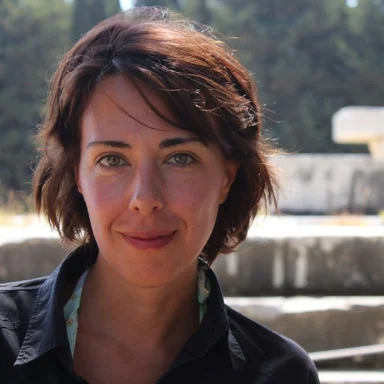
Nicla Panciera
science journalist
Freelance science and health journalist. Science and medical writer. She writes for the Italian newspapers La Stampa, Repubblica, for Vita Non Profit, for the monthly magazine Le Scienze and Mind Mente e Cervello, where she runs Altre Menti, a column on animal cognition.
Past talks
Sat. 26 September
at 14:30 - 15:15
14:30 - 15:15
Saturday 26 September
Teatro Miela
Piazza Luigi Amedeo Duca degli Abruzzi, 3, 34132, Trieste, TS
Piazza Luigi Amedeo Duca degli Abruzzi, 3, 34132, Trieste, TS
TRIESTE
Undervalued and taken for granted – what has become of touch, the simplest and oldest of human acts? Touch conceals a whole world: it is a universal language, a dialogue between brain and skin, an act of care and a form of resistance in an age when bodies are drifting apart. Central to the myths of the Odyssey and examined by philosophy ever since Aristotle, touch is at last being studied by neuroscience, which reveals its essence: from the caresses that ease pain in palliative care to the nerve fibres that turn a massage into well-being; from the fragility of those who shut themselves off from contact to the skin hunger that breeds mental distress. In society, touch reflects different ideas of the body, of identity and of culture: the synthetic skin of robotics, social touch, the evolution of greetings, medical handling, no-touch policies in schools, and research on the Piezo channels of Nobel laureate Ardem Patapoutian and the C-tactile fibres of affective touch. These are the pieces of the mosaic that neuroscientist and science writer Marta Paterlini assembles in “La pelle che pensa” (The Thinking Skin), showing how touch today is suspended between taboo and necessity, fear of contact and a desperate need for connection. Because to touch is to care, to speak, to exist.
Incontro con l’autrice finalista
Location: Teatro Miela - Piazza Luigi Amedeo Duca degli Abruzzi, 3, 34132, Trieste
speakers
Sat. 26 September
at 10:00 - 11:15
10:00 - 11:15
Saturday 26 September
Area Talk 1
Piazza Unità d'Italia, 34121, Trieste, TS
Piazza Unità d'Italia, 34121, Trieste, TS
TRIESTE
Among the many risk factors for cancer, one stands out as particularly difficult to address for practical reasons: ageing. As we grow older, the risk of developing cancer increases significantly, making ageing one of the most important cancer risk factors. At the same time, data from several countries indicate a worrying rise in the incidence of certain cancers—most notably colorectal cancer—among younger adults. This emerging trend is the focus of intense scientific investigation aimed at understanding its underlying causes and assessing its implications for cancer prevention and public health. Fondazione AIRC invites you to join a discussion on the relationship between cancer and age. Together, we will explore why ageing is such a major determinant of cancer risk, examine the hypotheses researchers are investigating to explain the increasing incidence of certain cancers in younger populations, and discuss how research is helping to shape new strategies for cancer prevention, early detection, and treatment.
Location: Area Talk 1 - Piazza Unità d'Italia, 34121, Trieste
speakers