This content is not yet available in English. You are viewing the original text.
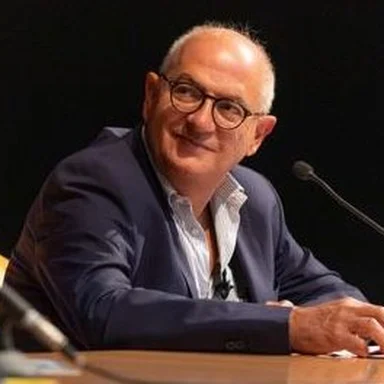
Marco Panara
editorialista quotidiani Gruppo NEM Nord-Est Multimedia
Past talks
Sun. 27 September
at 10:00 - 10:45
10:00 - 10:45
Sunday 27 September
Teatro Miela
Piazza Luigi Amedeo Duca degli Abruzzi, 3, 34132, Trieste, TS
Piazza Luigi Amedeo Duca degli Abruzzi, 3, 34132, Trieste, TS
TRIESTE
There is an invisible web of life on Earth, and we are part of it. Microbes are its ancient weavers: they regulate the cycles of the planet and safeguard the health of plants, animals and people. A few are dangerous; many protect us. In the fragile times we are living through, marked by crises of health, climate, ecology and energy, the invisible is part of the threat – but it can also become our greatest ally, provided we pay attention to it and take care of it. Our guide to these discoveries is Antonella Fioravanti, a scientist of international standing who is credited with defeating a super-pathogen that has killed thousands and spread terror throughout history: anthrax. Using a strategy of her own devising – a nanobody able to work its way into the bacterium’s armour and destroy it – she moved science a step forward in the long marathon of curing disease. Weaving the latest scientific findings together with her own story, drawing us into her work as a researcher and looking to the future both as a woman of science and as a mother, Antonella Fioravanti describes the challenges we will face in responding to the impact of climate change on micro-organisms, a field still largely unexplored in which she is a genuine pioneer. This highly original and gripping book is a journey into the microcosm that lives within us and around us, where science, history, biodiversity and wonder intertwine. Because knowing about microbes today is not only a scientific matter but a responsibility towards the planet and humanity. Only by granting them a role in our future can we build a future that is sustainable.
Incontro con l’autrice finalista
Location: Teatro Miela - Piazza Luigi Amedeo Duca degli Abruzzi, 3, 34132, Trieste
speakers
Sat. 26 September
at 18:00 - 19:15
18:00 - 19:15
Saturday 26 September
Teatro Miela
Piazza Luigi Amedeo Duca degli Abruzzi, 3, 34132, Trieste, TS
Piazza Luigi Amedeo Duca degli Abruzzi, 3, 34132, Trieste, TS
TRIESTE
What is the relationship between being and thinking? Vittorino Andreoli approaches the question as a psychiatrist: thought is not an abstract entity but a biological function, one that arises from billions of neurons, synapses and neurotransmitters and is reshaped by experience through the plasticity of the brain. If the brain is matter, thought is what that matter produces in relation to others: we think because we are bodies embedded in an environment and in a history. Hence the open questions: how much of thinking we can observe and measure, how much lies beyond the reach of our instruments, why two brains with the same biology arrive at different thoughts. Thought not as a certainty, but as the living process that defines us.
Location: Teatro Miela - Piazza Luigi Amedeo Duca degli Abruzzi, 3, 34132, Trieste
speakers